

When sensitive skin begins to sting, a crowded bathroom shelf can make the cause almost impossible to read. A cleanser changes on Monday, a treatment arrives on Wednesday, and a new sunscreen enters the routine before the weekend. Meanwhile, facial mist, makeup, hand cream, shaving, weather, heat, and mask wear continue in the background.
This anonymized case began with that kind of layered daily stack. Recurring redness and stinging had prompted successive product trials, yet each change introduced another variable. The resulting fatigue was practical as much as physical: every fluctuation seemed to demand a purchase, while no stable routine remained long enough to serve as a comparison.
The reset focused on fragrance because it crossed several product categories, including scented extras. Fragrance was a working variable rather than a confirmed diagnosis. The useful lesson lies in the method: inventory every exposure, establish a modest baseline, record observable responses, and return products one at a time.
What's Inside
- Why fragrance became difficult to trace
- How redness and stinging were recorded
- What the product audit included
- How the simplified routine was built
- How products returned one at a time
- What the case notes could establish
- Which shopping rules remained
- How to choose the next step
Why Fragrance Became the Most Elusive Variable
Personal-care routines were once relatively compact for many users: cleanse, moisturize, and attend to daytime protection. Contemporary routines can place a rinse-off cleanser beneath several leave-on treatments, moisturizer, sunscreen, makeup, mist, and scented extras within the same daypart. That layering matters because a response belongs to the whole exposure pattern until the variables are separated.
In this case, fragrance appeared across enough categories to merit controlled attention. It could have reached facial skin through an obvious scented product or through a less memorable exposure, such as fragranced hand products transferred while touching the face. Repetition also obscured timing. Stinging during application provides a different clue from discomfort that develops later, but crowded routines make either pattern hard to associate with one bottle.
Fragrance is not universally harmful, and the case did not establish it as the sole cause. Essential oils, botanical extracts, and individually listed fragrance-related ingredients also resist simple classification. Their presence can guide follow-up without proving that a particular material caused a reaction.
“A useful reset creates a readable baseline. Its value comes from controlling the routine closely enough to distinguish observation from assumption.”
The decision, then, was deliberately narrow: reduce simultaneous variables first. That move replaced speculative shopping with a documented approach, where each product had a stated function and each change left a traceable record.
The Redness-and-Stinging Pattern That Ended Casual Swapping
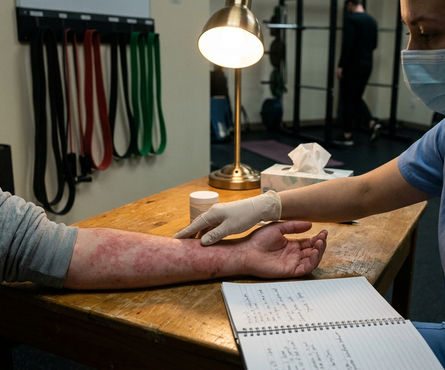
The pre-reset notes described recurring visible redness, stinging during or after application, and uncertainty about which product mattered. No single application stood out as the definitive event. The pattern accumulated across successive changes until informal product swapping ceased to yield useful information.
The baseline was recorded in four observable lanes:
- Sensation: whether stinging occurred during application or emerged afterward.
- Visible signs: where redness appeared and whether it remained limited or spread.
- Timing: the relationship between product use and the observed response.
- Concurrent exposures: heat, shaving, weather, or mask wear around the same period.
This vocabulary was intentionally descriptive. “Redness after moisturizer” preserves more useful information than an unsupported diagnostic label. The same discipline applies to stinging: its onset, location, and course belong in the record, while the presumed cause remains provisional.
Environmental and behavioral factors stayed in view because skin does not encounter formulations in isolation. Heat can alter the experience of a product. Shaving changes the condition of the application area. Mask wear adds friction and occlusion. Weather may coincide with dryness or discomfort. Recording those factors does not explain the reaction by itself; it prevents them from disappearing from the comparison.
Stop Signals
Home experimentation should stop if swelling, blistering, eye or lip involvement, breathing difficulty, rapidly worsening symptoms, or persistent discomfort appears. Marked burning or spreading redness also calls for caution rather than another product trial.
Continuing to rotate products would have preserved the same uncertainty. A new treatment could coincide with improvement, worsening, a weather shift, or the withdrawal of a previous item. Without a stable comparison point, even a careful observer ends up interpreting noise.
Every Face-Relevant Product Entered the Audit
The audit began before elimination. Memory tends to favor serums and moisturizers while overlooking rinse-off products, makeup, masks, facial mists, sunscreen, and whatever remains on the hands. A written inventory corrected that bias.
What Was Counted as Exposure
- Leave-on skincare, including treatment steps and moisturizer
- Rinse-off cleansers and other products used on facial skin
- Daytime sunscreen
- Makeup and facial mists
- Masks and optional scented extras
- Fragranced hand products that could transfer to the face
Each entry carried the exact product name, its function, the full ingredient list, and the first-use date when that date was known. The record also specified application area, frequency, and whether discomfort appeared immediately or later. “Used often” proved less useful than a direct note about where and when the product entered the routine.
Fields used for the sensitive-skin product inventory| Field | Reason for recording it |
|---|---|
| Exact name and function | Distinguishes products with similar packaging or overlapping purposes. |
| Full ingredient list | Supports label review without relying on front-of-pack language. |
| First-use date, if known | Places the item within the sequence of routine changes. |
| Application area and frequency | Clarifies exposure rather than assuming full-face daily use. |
| Immediate or delayed discomfort | Separates different timing patterns for later comparison. |
Reading Fragrance Language Without Declaring Villains
Clear fragrance-free labeling served as an initial screen, followed by inspection of the full ingredient list. “Unscented” alone was not accepted as proof of suitability because that wording did not rule out masking agents. The audit also flagged fragrance-related terms, essential oils, and botanical extracts for controlled follow-up rather than treating each one as an automatic offender.
The FDA overview of allergens in cosmetics provides useful regulatory context for cosmetic allergens and labeling. Even so, a label review cannot reproduce diagnostic testing or determine the cause of an individual response.
Label Discipline
Photograph or transcribe the complete ingredient list when a product enters the audit. Front-label claims belong beside that record, never in place of it.
A Functional Routine Replaced the Crowded Shelf
Simplification came before replacement. That sequence reduced the temptation to answer each fluctuation with another active and preserved a clearer baseline for comparison.
The functional core comprised gentle cleansing as needed, one straightforward moisturizer, and suitable daytime sun protection. This was a case framework rather than a universal prescription. Prescription products, clinician-directed care, and essential sunscreen decisions were left unchanged unless a qualified professional advised otherwise.
The Selection Screen
Potential essentials were assessed using a short set of practical criteria:
- Clear fragrance-free labeling accompanied by a full ingredient check
- A manageable ingredient list that could be recorded accurately
- A familiar texture that did not create a new sensory obstacle
- Practical availability for consistent use
- A defined function without duplicating another product
Manageable did not mean that a shorter formula was inherently safer. It meant the user could understand what role the item served and could compare it with later candidates. Texture also deserved attention. A theoretically appealing moisturizer offers little practical value if its feel encourages erratic application or immediate replacement.
No fixed reset calendar was imposed. Progress depended on symptom stability and professional guidance where needed, rather than an invented deadline. That restraint matters in an anonymized, self-reported case without documented formal allergy testing; the record cannot assign population-level blame to fragrance.
A Daily Record Small Enough to Keep
The daily log included:
- Product used and application time
- Stinging: none, during application, or after application
- Visible redness: none, limited, or spreading, with rough duration when present
- Dryness and itch
- Relevant weather, shaving, heat, or mask exposures
The log avoided interpretive prompts such as “Did fragrance irritate the skin today?” That wording would bias the record toward the working theory. Observable fields allowed a later reader to examine the sequence without inheriting the initial assumption.
Baseline First
Keep the core routine steady while the pattern is being read. A stable fallback is more informative than a shelf of products added in response to individual symptom days.
Patch Checks Opened the Door to One Product at a Time
Once the baseline was sufficiently stable to support a new comparison, candidates returned according to routine need. A product filling a genuine care gap took priority over optional fragrance, masks, or overlapping treatments.
The operating sequence was straightforward:
- Review the complete ingredient list again.
- Select one nonessential candidate.
- Use an informal check only on intact skin.
- Follow the product’s labeled directions.
- Document the location, timing, and observed response.
- Hold all further additions while the result remains unclear.
An at-home patch check and formal diagnostic patch testing answer different questions. The home check is a cautious exposure to one consumer product under limited conditions. Diagnostic patch testing is performed and interpreted by a qualified clinician. A quiet informal check on intact skin did not guarantee tolerance during repeated full-face use, particularly when heat or mask wear later changed the exposure conditions.
That distinction prevented false reassurance. Passing a small-area check meant only that no concerning response had been observed under that particular use. It did not certify the formula as universally compatible or exclude a delayed problem.
When the Test Ends
Marked burning, spreading redness, swelling, blistering, or a reaction that continued to worsen were stop conditions. The purpose of staged reintroduction was to obtain a readable result, not to push through escalating symptoms for the sake of completing an experiment.
One-Change Rule
Change one variable, write down when it changed, and wait for a readable result before making the next decision.
This rule also reduced product fatigue. Curiosity could remain in the design notebook without becoming an immediate purchase. Products earned a place by function and tolerability, while optional additions waited until the preceding change could be assessed.
What Improved, and What the Case Could Not Establish
Improvement during the fragrance-free phase appeared in the case record as an observation. It did not prove that every fragrance ingredient caused the earlier redness or stinging, nor did it identify one confirmed allergen.
The comparison used only fields available in the notes: products in active rotation, symptom days, time from application to stinging, duration of visible redness, reliance on rescue products, and products tolerated after reintroduction. Counts, durations, percentages, and a fixed timeline were absent from the source notes, so they remain unreported rather than reconstructed.
Outcome fields available from the reset notes| Comparison field | Reporting status |
|---|---|
| Products in active rotation | Compared qualitatively |
| Symptom days | Count not recorded |
| Time from application to stinging | Exact durations not recorded |
| Duration of visible redness | Exact durations not recorded |
| Reliance on rescue products | Compared qualitatively |
| Products tolerated after reintroduction | Identified through the staged process |

Three evidence layers must remain separate. Contemporaneous participant notes captured observations near the time of use. Retrospective reconstruction organized the sequence after the fact. Editorial guidance translated that process into a cautious method readers can adapt. Blending those layers would make the account sound more certain than its record permits.
The durable outcome was procedural: fewer simultaneous variables and a repeatable method for evaluating additions. That method retains value even when the reset cannot deliver clinical proof. It turns a chaotic rotation into a traceable series of decisions.
The Fragrance-Free Shopping Rules That Survived the Reset
The post-reset buying order began with function. Define the care gap, read the full ingredient list, introduce one item, and preserve the fallback routine. This order placed the needs of the routine ahead of launches, scent preferences, or the promise of a more elaborate regimen.
Function Before Novelty
- Buy for a named purpose rather than a general hope of calmer skin.
- Check the complete ingredient list even when the front label says fragrance-free.
- Avoid launching several unfamiliar products together.
- Keep known, tolerable essentials available during evaluation.
- Decline duplicate products that perform the same routine function.
Fragrance-free remained one screening criterion. It offered no guarantee of gentleness, safety, or universal compatibility. Other formula components, application patterns, and concurrent exposures still mattered. Likewise, unscented labeling without a full ingredient read remained too weak as a stand-alone test because masking agents could still be present.
These rules also support sustainable living. Repeated speculative replacements create waste and make the routine harder to interpret. Consistent use of tolerable essentials can serve both a mindful home and a sensitive-skin record more effectively than a procession of partially used bottles.
The resulting shelf may look modest. Its strength lies in legibility: each item has a job, each addition has a date, and the fallback routine remains intact when an experiment needs to stop.
Choose the Next Move From Your Own Notes
The Reset Sequence
Audit before buying; simplify before testing; change one variable at a time; document observable responses; escalate concerning symptoms.
Three proportionate actions follow from that sequence.
- Simplify one nonessential variable. Remove one optional product while preserving essential, prescribed, or clinician-directed care. Record what changed and when.
- Reintroduce one needed product cautiously. Choose an item that fills a genuine care gap, review its ingredients, use intact skin, follow its directions, and postpone every other addition.
- Pause experimentation and seek professional assessment. This path fits recurring reactions with an unclear trigger, symptoms that persist despite simplification, or any concerning escalation.
A fragrance-free reset can create order without pretending to deliver a diagnosis. Its most useful contribution is a cleaner decision trail: what touched the skin, when it changed, what was observed, and which variable should move next.
Based on your symptoms and notes, is your next move to simplify one variable, reintroduce one product, or stop and seek professional care?