
A bathroom refill system sounds serene until it begins to look like a storeroom. One pouch leans behind the basin trap. A second bottle waits in the shower niche. A jar with no label sits beside the cotton pads, looking faintly medicinal and entirely unhelpful.
The aim is not to build a perfect zero-waste bathroom. It is to create a small, repeatable household routine that reduces packaging, keeps products legible, and leaves the room feeling calmer than it did before.
What's Inside
- Why Bathroom Refill Systems Often Become Clutter
- Before You Decant: Hygiene, Labels, and Product Safety
- Audit What You Actually Use Before Buying Refills
- Tip: Use the One-in-Use, One-Backup Rule
- Build the System: Dispensers, Storage, Decanting, and Maintenance
- Key Takeaway: A Refill System Is a Routine, Not a Stockpile
- Editorial Note from olivinelife
Why Bathroom Refill Systems Often Become Clutter
Good intentions often arrive in the bathroom before the storage plan does.
I have seen beautiful low-waste setups collapse under very ordinary pressure: two half-used shampoo pouches, a concentrate bought on sale, three amber bottles that do not quite pump properly, and a cupboard shelf that now requires a small negotiation every morning. The bathroom has not become more sustainable in any practical sense. It has become busier.
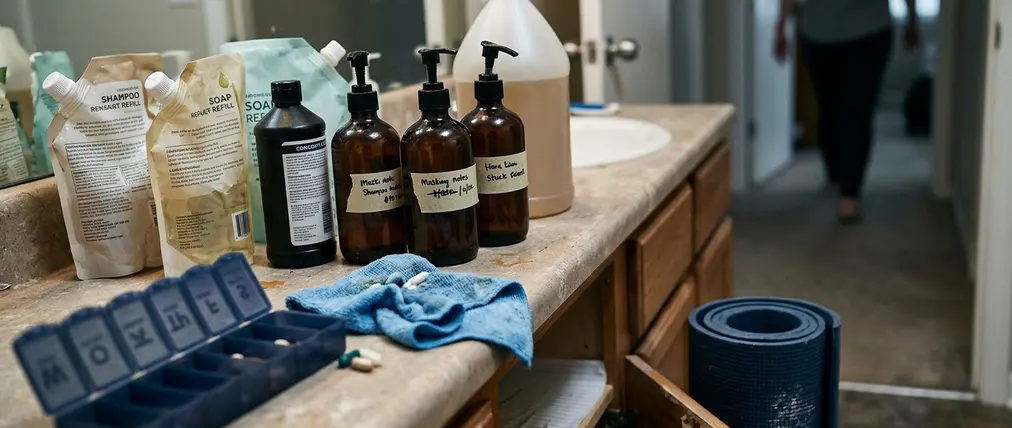
A refill system is not just the act of buying refills. It is a household workflow: inventory, storage, decanting, cleaning, labelling, and knowing when not to buy. Without that workflow, refills become another category of clutter, only softer-looking and harder to throw away.
The most useful question is not, “How can I replace every product with a refill?” It is, “Which products do we use often enough to deserve a permanent place in the system?” That single shift keeps the design grounded in real life.
A calm bathroom usually has fewer visible products, not more attractive containers. A dispenser on the basin can feel settled. Six matching bottles in the shower can still feel like visual noise if only two are used daily.
Before You Decant: Hygiene, Labels, and Product Safety
Note: Not every product should be decanted, diluted, mixed, or stored outside its original packaging. Treat the original container as part of the product information, not just disposable wrapping.
This matters most with water-based personal care products. Hand soap, shower gel, shampoo, conditioner, and some cleaning concentrates all need sensible handling. If a dispenser is topped up again and again without being properly washed and fully dried, residue and moisture can linger inside the pump, cap, or bottle shoulder.
Product safety begins before the refill is opened. Read the brand instructions for concentrates, dilution ratios, expiration guidance, and compatible containers. Some formulas are designed for a specific bottle or spray mechanism. Others may not suit clear glass, metal caps, or long storage once diluted.
Labels are part of hygiene too. A bottle marked “bathroom cleaner” is clearer than a bottle that relies on memory. Add the product name and refill date with a waterproof marker or a durable label. In high-humidity rooms, paper labels tend to surrender quickly, so choose something wipeable or accept that relabelling belongs to the routine.
Our testing revealed a simple rule that holds up well in domestic bathrooms: decant with a funnel, keep a cloth nearby, label immediately, and clean the dispenser fully before the next refill. Full drying is not decorative perfection. It is the practical step people most often skip.
This is household organisation, not a preservation method for unstable formulas.
Audit What You Actually Use Before Buying Refills
Begin with an empty surface, even if it makes the room look worse for twenty minutes.
Remove everything from the shower, vanity, medicine cabinet, under-sink area, and linen shelf. Put it all in one visible place. This is the moment when duplicate purchases become obvious: the spare cleanser bought during travel, the conditioner nobody liked, the nearly empty body wash kept because it feels wasteful to discard.
Sort the items into four groups:
- Daily use: products used every day or nearly every day.
- Weekly use: masks, treatments, razors, cleaning sprays, or bath items used regularly but not constantly.
- Occasional use: travel-size bottles, guest items, seasonal products, or products kept for a specific need.
- Expired or unwanted: anything past its guidance date, changed in smell or texture, or simply no longer welcome in the room.
Only the first two groups should be considered for a refill system. The occasional group may need a small basket, not a subscription. The expired group needs responsible disposal according to local guidance and the product label.
Refill candidates are the products already in consistent rotation: hand soap, shower gel, shampoo, conditioner, and surface cleaner. If a product is not already being used reliably, buying it in a larger refill format usually turns uncertainty into storage burden.
For broader reuse habits, the EPA guidance on reducing and reusing household waste is a useful reference point. At home, keep the audit modest: review the refill zone monthly, or when the backup bin begins to feel crowded.
Tip: Use the One-in-Use, One-Backup Rule
Quick Tip: For each refillable bathroom product, keep one dispenser in use and one refill backup stored away. No third bottle “just in case.”
This rule works because it respects two opposing household instincts. One person worries about running out. Another sees the cupboard filling and wants everything pared back. One in use plus one backup gives both sides a boundary.
For hand soap, that might mean one pump dispenser on the sink and one pouch, tablet, or concentrate stored under the sink. For shampoo, it means one bottle in the shower and one refill pouch in a labelled storage bin. For bathroom surface cleaner, one spray bottle sits where it is used, while one concentrate or refill waits in the cleaning area.
Small households usually need fewer backup categories than multi-person homes. A single-person flat may not need backup conditioner and body wash and hand soap all at once. A family bathroom, especially one shared by guests or children, may need the rule applied more consistently so the system does not rely on one person’s memory.

The point is not scarcity. It is clarity. When the backup is opened, it becomes the visible cue to replace only that backup, not to browse an entire new suite of bathroom refills.
Build the System: Dispensers, Storage, Decanting, and Maintenance
Choose function first. The prettiest bottle is a poor choice if it clogs, slips from wet hands, or asks to be polished every other day.
Step 1: Match the dispenser to the product
Pump bottles suit hand soap and lotion. Squeeze bottles tend to work better for shower gel, shampoo, and conditioner because wet hands can control them easily. Spray bottles belong with bathroom cleaners, provided the product instructions allow that format. Jars should be reserved for dry goods only, such as bath salts or cotton rounds, and even then they need to live away from direct shower spray.
Do not use a beautiful vessel simply because it matches the tile. A bathroom is a high-touch, high-moisture room. Every object must earn its place.
Step 2: Standardise where it helps
Standardising bottle sizes can make a small bathroom look intentional. It also makes the refill zone easier to manage because you know which funnel fits, which labels stay put, and which containers can be cleaned with the same brush.
There is no need for every bottle in the home to match. The sink, shower, and cleaning cupboard have different jobs. A consistent family of shapes is often enough: simple pump by the basin, squeezable bottles in the shower, clearly marked spray bottle for cleaner.
Step 3: Choose materials for the actual room
Glass feels stable and elegant on a vanity, but it may be a poor choice on a tiled shower floor. Aluminum can work well for lightweight bottles, though it still needs clear labelling. Durable plastic is not a design failure if it prevents breakage in a family bathroom or rented home.
The right material depends on flooring, shower layout, grip, storage height, and who uses the room. A refill system should make daily use easier, not more precious.
Step 4: Create one quiet refill zone
Keep backups together in one moisture-resistant bin, tray, or basket. Under the sink is often practical if the area stays dry and ventilated. If the room is damp, move backups to a nearby linen cupboard instead of forcing everything into the bathroom.
Include the tools in the same zone: funnel, cloth, waterproof labels, marker, small bottle brush, and tray. When these pieces are scattered, refilling becomes a small domestic hunt.
Step 5: Clean before refilling
- Use up the remaining product where appropriate; avoid mixing old and new formulas unless the brand permits it.
- Wash the bottle, pump, cap, and thread thoroughly.
- Let every part dry fully before refilling.
- Decant with a funnel on a tray or folded cloth.
- Label with the product name and refill date.
- Return only the active dispenser and one backup to the system.
That last step is where the bathroom stays calm. The system is not finished when the bottle looks pretty. It is finished when the shelf still has breathing room.
| Bathroom zone | Best refill candidates | Storage note |
|---|---|---|
| Sink | Hand soap, lotion | Use a stable pump and wipe the base often. |
| Shower | Shampoo, conditioner, shower gel | Choose squeezable bottles with labels that tolerate steam. |
| Under-sink area | One backup per active product | Use a washable bin and check for leaks or dampness. |
| Cleaning area | Bathroom surface cleaner | Follow dilution and spray-bottle guidance from the brand. |
Key Takeaway: A Refill System Is a Routine, Not a Stockpile
Summary: The best bathroom refill system is small, visible only where useful, and easy to maintain.
If the room feels crowded, the answer is rarely another matching container. Return to the three-part framework: audit what you use, limit each refillable product to one in use and one backup, and clean dispensers fully before refilling.
Low-waste living should make the bathroom calmer, not more complicated. A clear pump on the basin, two well-labelled shower bottles, and a tidy refill bin can do more for the room than a cupboard full of aspirational purchases.
The quiet success of this system is that it almost disappears. You know where the backup lives. You know when to replace it. You know what is inside each bottle without unscrewing a cap and guessing by scent.
Editorial Note from olivinelife
This article was created for readers seeking practical, aesthetically calm, low-waste home routines. It reflects olivinelife’s editorial focus on holistic wellness, clean beauty, and mindful interiors, with recommendations kept to general household organisation rather than medical, cosmetic chemistry, or product safety advice.
Always check individual product instructions before decanting, diluting, mixing, or storing any personal care or cleaning product outside its original packaging.