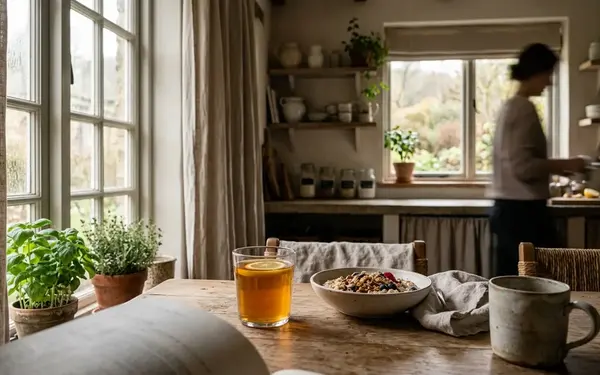

Quiet luxury is not defined by a neutral palette, a bouclé chair, a stone bowl, or the absence of visible branding. It is defined by how well a home holds up over time.
What's Inside
- Quiet Luxury Has a Durability Problem
- Why the Aesthetic Feels So Persuasive Right Now
- The Problem With Luxury as a Surface Treatment
- What Built-to-Last Quiet Luxury Looks Like
- The Counterargument: Not Everyone Can Buy Heirloom Pieces
- Tip: Build the Look by Editing Before Buying
- Key Takeaway: Quiet Luxury Should Feel Lived-In, Not Disposable
- About This Design Notebook Perspective
Quiet Luxury Has a Durability Problem
The most convincing quiet luxury rooms are not quiet because they are beige. They are quiet because nothing in them appears to be auditioning for attention.
That distinction matters. A room can wear linen, oak, stone, wool, and warm white paint and still feel nervous if every object has been chosen to resemble a trend photograph. The promise of the aesthetic is calm, restraint, tactile beauty, and fewer interruptions to the eye. The risk is that it encourages a new kind of speed: fast replication, only in softer colors.
I have seen the pattern often enough in homes, shops, and renovation moodboards. A person wants peace, so they buy the signs of peace. The pale chair arrives before anyone has considered the dog, the evening tea, the south-facing window, the muddy hallway, or the child who eats toast everywhere except at the table.
Before buying into the look, ask harsher questions. Can this object be lived with? Can it be repaired, cleaned, moved, aged, and loved after the first season of enthusiasm has passed? A useful evaluation sequence runs beyond the showroom moment and into roughly three to six months of home use, where contact, dust, sunlight, and small domestic accidents tell the truth.
Note: Quiet luxury fails when the photograph survives but the object does not.
Why the Aesthetic Feels So Persuasive Right Now
There is a good reason this look has travelled so far. Modern life is visually loud. Screens glow, packaging shouts, open shelves gather evidence, and many rooms now carry the residue of work, rest, exercise, childcare, and administration.
Against that, quiet luxury offers visual rest. Fewer objects. Softer contrast. Natural fibres under the hand. Muted stone, warm wood, linen curtains, wool rugs, leather that marks slowly, ceramic with a maker’s thumb still felt in the glaze, and unlacquered metals that darken rather than peel.
Restraint has legitimate design value. An edited room can reduce visual noise and make daily routines feel less interrupted. The coffee table does not need seven objects to prove taste. A hallway does not need a console if the wall hook and the bench already work. Fewer decisions can be a form of care.
The trouble begins when restraint becomes algorithmic sameness. Online, quiet luxury is often compressed into beige-on-beige rooms, identical sculptural lamps, fluted surfaces, curved accent chairs, and the same shallow bowl on the same oversized book. It is less a philosophy than a costume rail.
Real restraint leaves room for biography. A repaired oak table can sit beside a severe linen sofa. A salt-glazed jug can interrupt a clean shelf. The point is not to erase personality, but to stop making every surface perform.
The Problem With Luxury as a Surface Treatment
Luxury becomes fragile when it is treated as a finish rather than a standard.
A narrow set of colours and silhouettes can suggest refinement without delivering any of its substance. Pale upholstery may look composed on delivery, but in rooms with daily foot traffic and spill exposure, cleaning can become a routine of several weeks under normal household use. Veneer can chip within the first year or two of light daily contact when edges, corners, and drawer fronts meet ordinary life. Composite stone may mimic marble but offer little of marble’s capacity to be reworked, honed, or accepted as weathered.
None of this makes those materials automatically wrong. It does make them less honest when they are sold as permanence.
The life of an object includes extraction, manufacture, transport, maintenance, repair, and disposal. The U.S. EPA’s Sustainable Materials Management framework is useful here because it asks us to think beyond the purchase and into a material’s whole use cycle. Interiors rarely become more sustainable by swapping one trend surface for another.
Neutral does not mean timeless. A beige object can be just as trend-driven as a cobalt one if it lacks material integrity, useful proportion, and a credible future in the room. Sometimes colour is less guilty than pretending not to be fashion at all.

Refinement in a home is not silence. It is the absence of panic.
— Callum O'Shea, Lifestyle Editor & Design Critic
What Built-to-Last Quiet Luxury Looks Like
Start with a plain standard: a quiet luxury object should be materially honest, repairable where possible, proportionally useful, and able to age without becoming visually embarrassing.
Material honesty means the thing does not rely on disguise. Solid wood can be sanded and oiled. Stone can take marks differently depending on its type and finish. Linen creases because it is linen, not because it has failed. Wool will compress in paths of use. Cotton softens. Clay varies. Limewash blooms and shifts. Leather darkens at the touchpoints. Metal oxidises, especially when it is not lacquered into submission.
That list is not a shopping prescription. Natural materials can still be poor choices in the wrong room. Linen upholstery beside a heavily used kitchen entrance may become a cleaning project rather than a pleasure. Unsealed stone in a bathroom needs a user who understands water, soap, and patience. Patina acceptance also changes by climate: high-humidity homes ask different questions of timber, metal, and leather than arid interiors do.
Repairability comes next. Can the cover be removed? Can the feet be tightened? Can the shade be replaced? Can the timber surface be refinished? In owner-occupied spaces where hardware access is possible, solid wood surfaces under moderate use can often follow refinishing intervals of roughly two to three years, which gives the owner a maintenance rhythm rather than a replacement habit.
Patina is the moral centre of this aesthetic. Good wear deepens character. Poor construction simply reveals itself.
The Counterargument: Not Everyone Can Buy Heirloom Pieces
The obvious objection is also the important one: durable furniture, natural materials, and repairable craftsmanship often cost more upfront.
Not every renter can change flooring. Not every household can replace a sofa because the current one has the wrong legs or the wrong fabric. Some people are furnishing rooms between moves, caring responsibilities, limited savings, awkward leases, and the steady rise in basic household costs. A design argument that ignores that reality becomes decoration for guilt.
Quiet luxury does not have to mean buying heirloom pieces. It can mean buying less. It can mean keeping the lamp and changing the shade. It can mean secondhand sourcing, provided the frame, joints, smell, and upholstery condition are inspected before purchase; failure often begins when a bargain skips structural inspection. It can mean washable slipcovers, mending linen, polishing a table, removing surplus objects, or refusing the accent chair that exists only to complete a moodboard.
There is dignity in making a room better by doing almost nothing to it. Move the chair closer to the window. Take three decorative objects off the shelf. Let one good bowl have the table to itself. These are not consolation prizes. They are often the most mature design decisions in the room.
Summary: This is not a demand for perfect sustainability or museum-quality interiors. It is an argument for better decisions within real budgets and real homes.
Tip: Build the Look by Editing Before Buying
Quiet luxury is easier to purchase than to practise. The practical sequence is simple: remove, repair, re-place, then purchase.
1. Remove Visual Noise First
Clear the surfaces that have become storage by accident. Reduce duplicate decor. Group useful objects together instead of scattering them across the room. Let negative space do some of the work.
A calmer room often appears after the third object leaves, not after the first new object arrives.
2. Repair or Refresh What Already Exists
Oil a wood table. Replace tired lampshades. Mend linen napkins or curtains. Clean grout. Reframe art that has lived too long in a temporary frame. Tighten handles, hinges, and drawer pulls. If a chair is well made but visually exhausted, reupholstery may be more intelligent than replacement.
Quick Tip: Repair the object you use every day before upgrading the object guests notice first.
3. Re-Place Before You Replace
Move objects around the house before sending them out of it. A side table that feels mean beside a sofa may work as a bedside surface. A rug that looks tired in a sitting room may soften a study. A ceramic lamp can become more generous when it is freed from a crowded console.
4. Purchase Slowly and Specifically
Only buy after the room has revealed an actual need. The best quiet luxury purchases answer a practical condition: better reading light, a washable cover, a table large enough for daily meals, a rug that improves acoustics, a chair with the right seat depth for the person who actually sits there.
Specificity is protective. It keeps taste from being led around by novelty.
Key Takeaway: Quiet Luxury Should Feel Lived-In, Not Disposable
Quiet luxury is not a colour scheme. It is a commitment to longevity, proportion, material truth, and restraint.
A built-to-last room feels calmer because it asks for fewer replacements, fewer trend corrections, and fewer anxious purchases. The eye settles because the objects have earned their place. The hand trusts them. The room does not need to be continually restyled to remain persuasive.
If the aesthetic depends on disposable objects to signal refinement, it has already contradicted itself. The most elegant room is not the one that looks newest. It is the one that can absorb daily life without losing its nerve.
About This Design Notebook Perspective
This perspective reflects Olivine Life’s ongoing coverage of holistic interiors, natural materials, mindful consumption, and sustainable home aesthetics. The judgement changes with tenancy, climate, household routines, and the room’s tolerance for visible wear.
Recommendations here are editorial and intended to support thoughtful design decisions. They do not replace professional conservation, upholstery, building, or materials advice, especially where structural repair, specialist finishes, damp, fire safety, or heritage fabric are involved.